

Most parents skip right past Tristan. They assume biblical names matter most. But here’s what they’re missing: this name connects powerfully to Scripture’s deepest themes of redemptive suffering, perseverance through trials, and faith-driven restoration.
The Tristan meaning in Bible isn’t about literal appearance. It’s about thematic resonance with God’s transformative work. When you understand what does the name Tristan mean in the Bible, you unlock truths about sorrow transformed into hope, pain yielding divine purpose, and covenant faithfulness outlasting emotion.
This comprehensive guide explores Tristan biblical significance through Scripture, theology, and practical application for Christian families.
Is Tristan Actually in the Bible?
Let’s address this directly: No, the name Tristan in the Bible doesn’t exist. Not once from Genesis through Revelation.
No prophet carried this name. No apostle signed letters with it. King David never fought alongside a warrior named Tristan. This disappoints many parents searching for is the name Tristan in the Bible.
But here’s the liberating truth: absence from Scripture doesn’t equal spiritual emptiness.
Consider these powerful Christian names also absent from biblical pages:
- Christopher means “Christ-bearer” but never appears in Scripture
- Felicity represents joy yet remains biblically absent
- Grace as a name isn’t found despite being core theology
- Trinity describes God’s nature but isn’t used as a biblical name
The spiritual meaning of Tristan emerges through theological alignment, not scriptural listing. It’s about embodying biblical principles—endurance rooted in faith, strength through adversity, and restoration after suffering.
Is Tristan a biblical name in the technical sense? No. Does it carry profound biblical meaning of Tristan through thematic connection? Absolutely yes.
Some confusion stems from medieval texts mixing religious commentary with names like Tristram. But Tristan stands independently, carrying weight through biblical symbolism of names and centuries of Christian cultural adoption.
What Does Tristan Mean in Biblical Context?
Biblical context extends beyond literal scriptural presence to include thematic alignment with God’s redemptive patterns. Names gain spiritual meaning of Tristan when they reflect theological truths about God’s purpose in pain and transformation.
The Tristan name meaning Bible connection centers on Scripture’s recurring pattern: sorrow becomes the soil where faith grows deepest. From Job’s afflictions to Paul’s theology of suffering producing perseverance, this name embodies Christianity’s realistic yet hopeful worldview.
Think practically about Tristan meaning Christianity. When parents choose this name, they’re making a theological declaration: “We know life brings hardship. We believe God transforms pain into purpose. This name reminds us that sorrow transformed into hope defines the Christian journey.”
That’s profoundly biblical—captured not through ancient manuscripts but through trusting God’s plan across every Scripture page.
Why This Matters for Modern Families
Contemporary Christian parents often seek names reflecting authentic faith journeys. The Christian meaning of the name Tristan provides:
- Realistic acknowledgment that life includes trials
- Theological framework for processing difficulty
- Teaching tool for children about God’s sovereignty
- Testimony opportunity when explaining the name’s significance
- Biblical foundation rooted in redemptive narratives
The meaning of the name Tristan biblically isn’t about finding chapter and verse. It’s about aligning with Scripture’s overarching message of divine restoration through faith through suffering.
The Real Origin of Tristan—Celtic Roots Meet Christian Europe
Understanding Tristan’s etymology unlocks its spiritual symbolism. Two linguistic streams converge beautifully in this Tristan Christian name meaning.
The Latin Connection
The dominant etymology traces to Latin “tristis” meaning sorrowful or melancholic. Roman culture spread this linguistic root across Europe as Christianity expanded through Latin-speaking regions.
Early Christian communities intentionally chose names reflecting theological realities. They didn’t avoid sorrow—they embraced it as part of sanctification through trials. Parents recognized that God’s sovereignty works through difficulty, not despite it.
This Latin origin of Tristan shapes our understanding today. The name acknowledges painful reality while pointing toward divine transformation—perfectly capturing redemptive suffering theology.
Historical records show early Christians naming children after emotional or spiritual conditions they hoped God would transform. Names became prophetic declarations of faith-based name meanings.
The Celtic Alternative
Another etymology traces Tristan to Celtic origins. The Welsh “Drustan” or “Trystan” meant tumult or riot—not negative connotations but descriptions of strength, disruption of evil, and warrior spirit.
Celtic name Tristan meaning emphasized active resistance against darkness. Celtic Christianity maintained unique characteristics while embracing biblical truth. Names carried dual significance: earthly struggle paired with divine purpose.
The warrior imagery aligns perfectly with Ephesians 6’s armor of God and Joshua’s commands to be strong and courageous. This Drustan Celtic origin contributes powerful martial imagery to the name’s spiritual depth.
Medieval Synthesis
By medieval times, these streams merged. The Tristan and Isolde legend popularized the name across medieval Christian names in European Christendom. Despite problematic story elements, it embedded Tristan firmly in Western Christian culture.
| Origin | Meaning | Cultural Context | Spiritual Implication |
| Latin (tristis) | Sorrowful, sad | Roman Christian expansion | Acknowledges life’s pain |
| Celtic (Drustan) | Tumult, riot | Welsh Christian tradition | Emphasizes warrior spirit |
| Medieval synthesis | Sorrow with purpose | European Christendom | Combines vulnerability & valor |
Whether tristis meaning sorrowful or Welsh name Trystan meaning tumult, the name carried spiritual weight in Christian communities for centuries. Its Tristan name biblical symbolism evolved within explicitly Christian contexts, absorbing theological significance.
Biblical Themes That Mirror Tristan’s Meaning
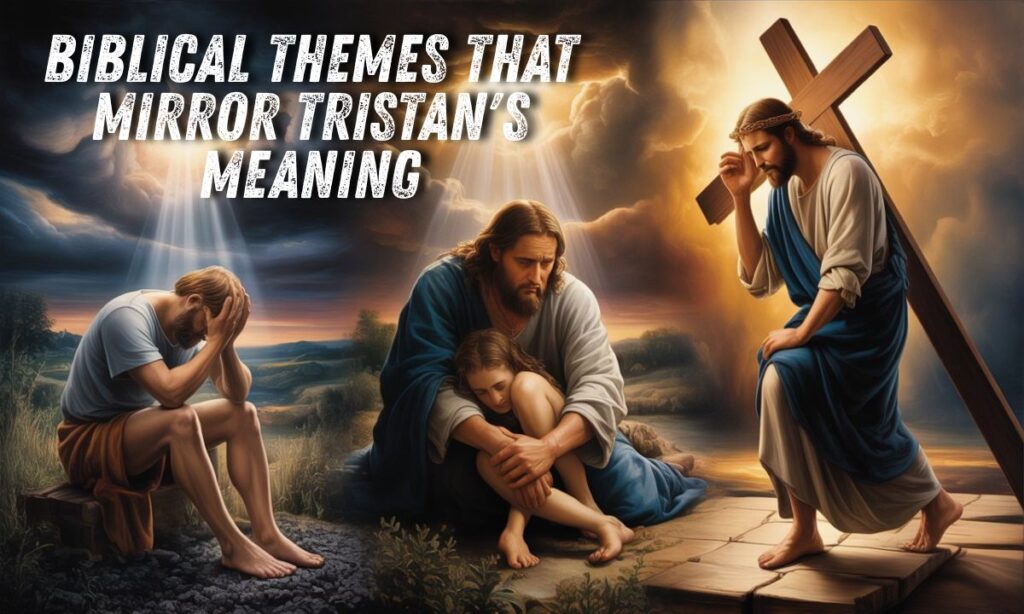
Scripture overflows with Tristan spiritual meaning. God’s Word repeatedly shows sorrow transformed by faith, grief redeemed, and pain producing perseverance.
Sorrow as Sacred Pathway
Job exemplifies biblical suffering transformed by faith. He lost everything—children, wealth, health, reputation. Yet God described him as blameless and upright.
“Naked I came from my mother’s womb, and naked I will depart. The Lord gave and the Lord has taken away; may the name of the Lord be praised.” — Job 1:21
Job’s journey perfectly maps onto Tristan meaning scripture. His suffering wasn’t random. God allowed it for purposes beyond immediate understanding. The book concludes with double restoration—divine restoration demonstrating God’s faithfulness.
Paul wrote extensively about redemptive suffering:
“I consider that our present sufferings are not worth comparing with the glory that will be revealed in us.” — Romans 8:18 meaning
This verse captures the essence of choosing a name meaning sorrowful. It acknowledges enduring hardship while pointing toward hope in Christ. Christian parents naming their son Tristan declare: “We know perseverance through trials matters, and trusting God’s plan prevails.”
Jesus himself blessed mourners: “Blessed are those who mourn, for they will be comforted” (Matthew 5:4 blessed are those who mourn). Sorrow in Scripture isn’t the end—it’s the beginning of God’s comfort in trials.
Tumult and Divine Purpose
Emphasizing the Celtic “tumult” meaning reveals different biblical parallels with equal power.
Jacob wrestled all night with God (Genesis 32:24-30). The encounter left him limping but blessed. God renamed him Israel—”one who struggles with God.” That tumult became a nation’s foundation.
Jacob’s physical struggle mirrored his spiritual growth through hardship. He emerged transformed, carrying new identity forged through conflict. This illustrates Christian perseverance through seemingly impossible circumstances.
Jonah experienced literal tumult—a divine storm sent because of disobedience. But that chaos led to Nineveh’s salvation. The prophet’s reluctant obedience after the storm demonstrates how God’s sovereignty uses even our resistance for biblical endurance and ultimate good.
Jesus calmed storms with a word: “Quiet! Be still!” (Mark 4:39). His power over natural tumult symbolized authority over spiritual chaos. Parents naming their child Tristan might draw from this imagery—God brings order from disorder.
From Grief to Glory
Joseph’s betrayal by brothers produced years of slavery and imprisonment. Yet he told those same brothers: “You intended to harm me, but God intended it for good” (Genesis 50:20).
That’s the redemption arc every Christian experiences.
King David wrote Psalm 30:5 explanation: “Weeping may stay for the night, but rejoicing comes in the morning.” Then verse 11: “You turned my wailing into dancing; you removed my sackcloth and clothed me with joy.”
These verses should hang in every nursery for a child named Tristan. They frame Tristan name meaning Christian within hope—sorrow exists, but it’s temporary. Joy follows inevitably.
Ruth lost her husband in a foreign land, returning to Israel as a childless widow—the lowest social status imaginable. Yet her story concludes with marriage to Boaz and inclusion in Christ’s lineage (Matthew 1:5).
Grief to glory indeed. Restoration after suffering defines Scripture’s narrative arc.
Also Read: 300+ Powerful Last Names That Mean Death
Five Spiritual Symbols Embedded in Tristan’s Identity
Let’s get practical. What Christian symbolism of the name Tristan carries significance for families?
1. Suffering as Sanctification
Romans 5:3-4 meaning provides theological framework:
“Not only so, but we also glory in our sufferings, because we know that suffering produces perseverance; perseverance, character; and character, hope. And hope does not put us to shame, because God’s love has been poured out into our hearts through the Holy Spirit.”
Notice the progression: suffering → perseverance → character → hope.
Naming a child Tristan acknowledges this biblical interpretation of Tristan pattern. You’re not cursing them—you’re declaring that when trials come, God uses them for sanctification through trials. The name becomes a teaching tool, a constant reminder that pain has divine purpose under God’s sovereignty.
Modern parents often shield children from difficulty. That’s not Christianity’s worldview. We prepare them to face hardship with faith, knowing perseverance through trials produces spiritual maturity (James 1:12 perseverance).
2. Redemptive Narrative Arc
Every biblical hero faces darkness before dawn:
- Moses spent 40 years fugitive before leading Israel
- David hid in caves while Saul hunted him
- Peter denied Christ thrice before becoming the rock
The pattern repeats: struggle → redemption → purpose.
A child named Tristan inherits this narrative framework. Their Tristan name and Bible verses connection points toward God’s redemptive plan in suffering. When they ask, “Why does my name mean sad?” you answer with Scripture: “Because God specializes in turning sorrow into strength.”
The “already but not yet” tension defines Christian existence. We’re saved (redemption accomplished) but await full restoration (glory revealed). Living between those realities requires endurance rooted in faith—exactly what this name emphasizes.
3. Warrior Perseverance
Ephesians 6:10-18 describes God’s armor protecting against spiritual attack. Christianity isn’t passive—it’s militant faith against evil.
Joshua received this command repeatedly: “Be strong and courageous. Do not be afraid; do not be discouraged, for the Lord your God will be with you wherever you go” (Joshua 1:9).
Strength through adversity defines biblical heroes. They didn’t experience easy lives. They fought through pain, maintained trust in God, and emerged victorious through biblical endurance.
Tristan, as Christianized European names go, channels warrior spirit. The Celtic roots emphasizing tumult align perfectly. Your son won’t avoid battles. He’ll face them head-on, armored in faith, knowing victory belongs to God.
Hebrews 12 endurance calls believers to “run with perseverance the race marked out for us, fixing our eyes on Jesus, the pioneer and perfecter of faith.”
That’s the Tristan calling—spiritual resilience rooted in Christ.
4. Covenantal Faithfulness Over Emotion
Here’s where we address the Tristan and Isolde legend directly.
That medieval legend centers on forbidden love and tragic romance—a fate-centered narrative where passion overrides commitment. The lovers betray covenant faithfulness for emotional fulfillment.
Biblical meaning stands in stark contrast.
1 Corinthians 13 defines love not as feeling but as action: patient, kind, not self-seeking. It’s covenant love honoring promises despite emotional fluctuation.
Hosea’s faithful love for an unfaithful wife mirrors God’s relationship with Israel. That’s sacrificial love—choosing commitment over convenience, demonstrating Christian principles.
Parents choosing Tristan can reclaim the name from legendary narrative. You’re declaring that any heartbreak your child experiences will be processed through biblical values, not cultural romanticism. Christian truth supersedes medieval storytelling.
Covenant beats emotion every time—the lesson embedded in biblically-informed Tristan biblical significance.
5. Beauty From Ashes Restoration
Isaiah 61:3 restoration prophesies that God will “provide for those who grieve in Zion—to bestow on them a crown of beauty instead of ashes, the oil of joy instead of mourning, and a garment of praise instead of a spirit of despair.”
Jesus Christ read this passage in the synagogue, declaring its fulfillment (Luke 4:18-21). This is hope in Christ crystallized.
God’s purpose includes taking broken things and making them beautiful. The cross demonstrates this—humanity’s darkest moment became eternal salvation’s source through divine restoration.
Lazarus died and decayed. Jesus wept at the tomb. Then he shouted, “Lazarus, come out!” Death surrendered to life (John 11).
The prodigal son squandered everything in wild living. He returned broken, ready to beg for servant status. His father ran to embrace him, threw a party, and restored his position (Luke 15).
Every parent hopes their child avoids pain. That’s impossible. A name like Tristan teaches them to expect restoration after suffering—to look beyond immediate pain toward God’s promised redemption and future hope.
Tristan as a Christian Name—The Verdict

So, is Tristan a good Christian name? Absolutely yes—with biblical understanding.
What Makes Any Name “Christian”?
Names don’t appear in heaven stamped “approved” or “rejected.” Biblical figures bore names common to their cultures. Ruth wasn’t Hebrew originally—she was Moabite. Yet she’s celebrated in Scripture.
Early Christian martyrs carried names from pagan origins. Augustine comes from Augustus (pagan emperor). Benedict means blessed but never appears in Scripture. Cecilia derives from a Roman family name.
The Christian worldview sanctifies cultural elements, redeeming them for kingdom purposes. A name becomes Christian through the faith of those bearing it, not through etymological purity.
Historical Precedent
Church history overflows with saints bearing non-biblical names. Medieval European Christians baptized thousands of boys named Tristan. It’s not new or experimental—it’s historically Christian.
The name entered Christian usage centuries ago, embedded in Western Christian culture. Godly people carried it faithfully across generations, giving it spiritual legitimacy through covenant faithfulness lived out.
Intention Matters Most
Naming theology emphasizes parental heart over linguistic origin.
If you choose Tristan to honor the medieval legend’s adultery, that’s problematic. If you choose it to remind your child that God works through suffering, that’s biblical. The difference lies in intention and teaching.
David means “beloved”—beautiful meaning. Yet King David committed adultery and murder. The name didn’t dictate behavior—faith and choices did.
Similarly, Tristan’s meaning of sorrow doesn’t curse your child. It prepares them to face reality with hope rooted in divine purpose, teaching spiritual lessons about God’s transformative work.
Practical Considerations for Choosing Tristan
Before finalizing any name, consider:
- Pronunciation in your cultural context
- Potential nicknames (Tris, Stan, Tan)
- Sibling name coordination and family flow
- Family heritage honoring considerations
- Testimony opportunities the name creates
That last point matters significantly. Unique faith-based name meanings open conversations about Christianity. When someone asks, “Why Tristan?” you share biblical themes of redemptive suffering through pain. The name becomes evangelistic.
Better Than Many “Biblical” Names
Here’s controversial truth: some directly biblical names carry problematic associations.
Jezebel appears in Scripture but represents wickedness. Judas obviously has issues despite biblical presence. Cain murdered his brother. Absalom rebelled against his father.
Meanwhile, Tristan—absent from Bible pages—aligns with core biblical themes of transformation through suffering, perseverance in trials, and faith-driven restoration.
I’d argue that makes it more biblically sound than some actual scriptural names. Thematic alignment with God’s redemptive work matters more than ancient manuscript appearance.
Separating Medieval Legend from Biblical Truth
We can’t discuss Tristan name meaning Bible without addressing Tristan and Isolde honestly.
The Legend’s Basic Plot
The medieval legend tells of a knight falling desperately for his uncle’s bride. A love potion causes forbidden passion. They engage in affair, leading to exile and eventual death.
It’s tragic romance at finest—and completely incompatible with biblical values.
Where the Legend Conflicts with Scripture
Adultery breaks the seventh commandment (Exodus 20:14). The legend romanticizes covenant-breaking. Emotional passion overrides marital commitment—exactly what 1 Corinthians 13 warns against.
The story operates under fate, not divine purpose. Characters are victims of circumstances beyond their control. That’s not the Christian worldview. We believe in free will, moral responsibility, and God’s sovereignty working through human choices.
The ending emphasizes tragic despair rather than redemptive hope. Both lovers die without restoration or redemption. It’s anti-gospel—the opposite of hope in Christ.
| Medieval Legend | Biblical Truth |
| Love ends in tragedy | Love leads to life and redemption |
| Sorrow consumes and destroys | Sorrow refines and strengthens |
| Fate controls destiny | God guides faithfully |
| Despair dominates | Hope prevails through Christ |
| Death is final | Resurrection promised |
Where It Aligns (Sort Of)
The legend contains elements of sacrificial love—characters suffer for another’s sake. That theme resonates biblically when properly directed toward covenant relationships.
Loyalty appears throughout, though misdirected. The Bible values faithfulness to proper covenant relationships, not illicit affairs.
Both elements exist in perverted forms within the legend. They need redemption themselves—filtering through biblical values to extract truth from error.
Redeeming Cultural Narratives
Christian parents constantly face this challenge. Culture produces stories containing both truth and error.
Your job isn’t rejecting everything non-biblical. It’s filtering culture through Scripture, keeping what aligns with Christian truth and discarding what contradicts it.
You can name your son Tristan while explicitly teaching the legend’s failures. Use it as case study in covenant love versus emotional passion. Show him how biblical hope defeats tragic despair.
Paul did this with Greek philosophers, quoting them while correcting errors (Acts 17). We do the same with Christianized European names and cultural inheritance.
How to Frame the Name’s Legacy
When your child asks about their name, say this:
“Your name means ‘sorrowful,’ but in our family, it means something beautiful. It reminds us that God uses hard things to make us strong. Like Job, like Ruth, like everyone biblical who faced pain and found God’s plan in it. You’re named Tristan because we believe God will turn any sorrow in your life into something amazing.”
That’s Christian framing—acknowledging reality while anchoring in divine meaning and trusting God’s plan.
Bible Verses Perfect for a Child Named Tristan
Every child deserves verses speaking to their name symbolism. Here are seven perfect scriptures for any Tristan, creating powerful Tristan name and Bible verses connections:
Jeremiah 29:11
“For I know the plans I have for you, declares the Lord, plans to prosper you and not to harm you, plans to give you hope and a future.”
Application: Your name acknowledges life’s difficulties, but this verse promises that God’s good plan prevails. Divine intentions supersede temporary sorrow, demonstrating trusting God’s plan in action.
Psalm 147:3
“He heals the brokenhearted and binds up their wounds.”
Application: God heals the brokenhearted as His specialty. He sees your sorrow and brings restoration after suffering. This verse promises emotional healing through prayer and divine comfort.
2 Corinthians 4:17
“For our light and momentary troubles are achieving for us an eternal glory that far outweighs them all.”
Application: Any suffering you face is temporary; the glory coming is eternal. This verse captures Tristan meaning in Bible perfectly—present pain yields future reward through faith through suffering.
Romans 8:28
“And we know that in all things God works for the good of those who love him, who have been called according to his purpose.”
Application: God uses everything—even pain—for good in your life. Sorrow transformed into hope through divine sovereignty and God’s purpose in pain working constantly.
Isaiah 43:2
“When you pass through the waters, I will be with you; and when you pass through the rivers, they will not sweep over you.”
Application: You’ll face trials, but God promises His presence through them all. Spiritual resilience comes from His constant companionship during enduring hardship seasons.
James 1:12
“Blessed is the one who perseveres under trial because, having stood the test, that person will receive the crown of life that the Lord has promised to those who love him.”
Application: Your perseverance through trials earns eternal reward. Endurance rooted in faith produces divine blessing and crown of life promised by God.
Matthew 17:20
“Truly I tell you, if you have faith as small as a mustard seed, you can say to this mountain, ‘Move from here to there,’ and it will move. Nothing will be impossible for you.”
Application: Even small faith through suffering overcomes impossible circumstances. Trust in God moves mountains blocking your path, demonstrating strength through adversity.
Print these verses. Frame them. Teach them progressively. Let them define what Tristan spiritual meaning means in your home, creating lasting spiritual foundation for your child.
Frequently Asked Questions About Tristan Meaning in Bible
What does Tristan mean spiritually in the Bible?
Tristan spiritual meaning connects to themes of sorrow transformed by faith, perseverance through trials, and divine restoration. Though not appearing in Scripture, the name embodies biblical principles of endurance rooted in faith and trusting God’s plan through hardship.
Does Tristan have a biblical meaning?
Yes, through thematic alignment. The biblical meaning of Tristan emerges from Scripture’s recurring pattern of redemptive suffering—God transforming pain into purpose, demonstrating hope in Christ through every trial.
What does the name Tristan mean in prayer?
In prayer and reliance on God, Tristan symbolizes offering sorrow and weakness to God. It reflects a heart seeking peace and renewal through emotional healing through prayer, where God listens, heals wounds, and transforms sadness into strength through adversity.
Is Tristan a good Christian name?
Absolutely. Despite is the name Tristan in the Bible being answered negatively, the name carries profound Christian meaning through theological alignment with biblical themes of perseverance, covenant faithfulness, and restoration after suffering.
What is the Tristan name meaning in Greek?
Though not originally Greek, Tristan meaning in Greek contexts connects with sorrow, emotional depth, and resilience. Greek philosophy values emotional expression and perseverance, aligning with the name’s emphasis on spiritual growth through hardship.
Conclusion: Embracing Tristan’s Biblical Depth
The Tristan meaning in Bible contexts reveals profound spiritual symbolism despite its absence from Scripture. This name embodies redemptive suffering, perseverance through trials, and faith-driven restoration—core biblical themes threading through God’s Word from Genesis to Revelation.
Parents choosing Tristan declare that God’s purpose in pain transforms sorrow into strength, making it authentically Christian through theological alignment rather than direct scriptural appearance. The spiritual meaning of Tristan teaches that suffering produces perseverance, that covenant faithfulness outlasts emotion, and that restoration after suffering follows biblical patterns consistently.
Understanding what does the name Tristan mean in the Bible through relevant verses equips families with powerful truth. This name serves as constant reminder that sorrow becomes soil for faith, that endurance rooted in faith produces character, and that hope in Christ never disappoints.
The Christian meaning of the name Tristan ultimately reflects God’s promise: “Weeping may stay for the night, but rejoicing comes in the morning” (Psalm 30:5). It acknowledges life’s painful realities while anchoring firmly in divine restoration and trusting God’s plan.
Choose it prayerfully. Teach it faithfully. Trust that Christ defines destiny, not names—but Tristan beautifully points toward His transformative work in every believer’s life. The meaning of the name Tristan biblically declares that God specializes in turning sorrow into strength, making it a powerful testimony to faith through suffering and hope anchored in Christ’s redemptive power.
Print those Bible verses. Teach those spiritual lessons. Let Tristan become more than a name—let it become a lifelong reminder of God’s faithfulness through every season.

